


What really goes into the price of a fabricated metal part?
By Mark Walker
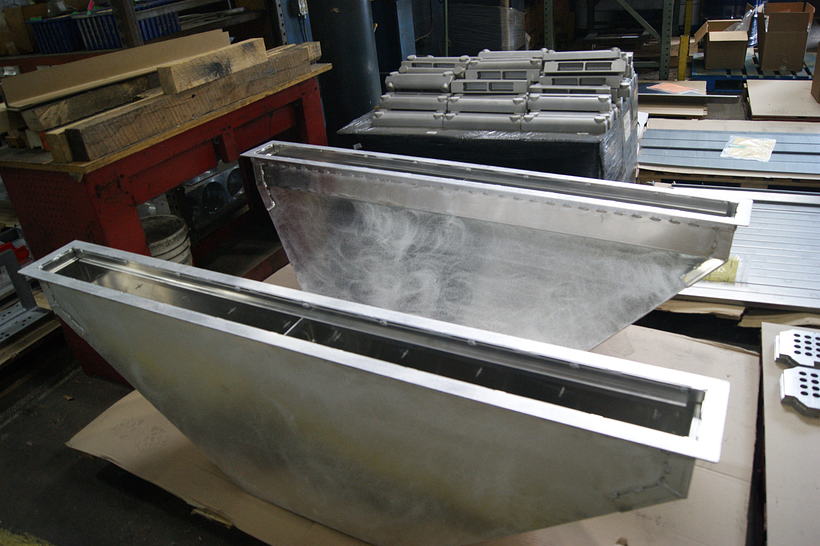
When someone looks at a fabricated metal part, it can be tempting to think about its cost in fairly simple terms:
- How much did the material cost?
- How many hours did it take to make?
Those numbers certainly matter. But in complex manufacturing, they are only part of the story. The true cost of producing a part also reflects everything required to make sure that part is manufacturable, repeatable to specification, delivered on time, and ready to work when it reaches the customer.
And often, much of that work happens before the first piece of metal is ever cut.
A Quote Is More Than Material + Shop Time
Every manufacturing project starts with obvious costs such as material, machining, welding, assembly, and finishing. There are also equipment, facility, and potentially subcontracting costs associated with production. But an accurate pricing strategy requires manufacturers to look much deeper.
At Metalworking Group (MWG), quoting a project means understanding the complete manufacturing requirements: tolerances, processes, finishing specifications, inspection requirements, fixtures, programming, packaging, freight, certifications, and documentation.
That approach matters because the goal isn’t simply to manufacture a part. The goal is to manufacture the right part, consistently, in a way that supports everything that happens next.
MWG’s internal production process reflects this broader approach, beginning with project discovery and a manufacturability review before moving through planning, first-article/quality validation, production, inspection, and delivery.
Engineering Happens Before Manufacturing
Some of the most valuable work on a manufacturing project can happen before production begins.
- Can a tolerance realistically be held?
- Could a slight design change make the part easier or more cost-effective to manufacture?
- Will the proposed weldment require dedicated fixturing?
- Are there features that could create assembly problems downstream?
- What inspection process will be needed to verify critical dimensions?
Those questions require experience and engineering judgment.
MWG engineers work directly from customer drawings or help develop CAD designs from customer ideas, while the broader manufacturing team identifies potential production challenges before fabrication begins. The objective is simple: solve problems early rather than discovering them after parts have already been produced.
That engineering support has a cost. But so does discovering a problem after 50, 500, or 5000 parts have been made.
Quality Has a Cost. So Does Poor Quality.
Inspection isn’t something that should simply happen at the end of a job. Quality has to be built into the manufacturing process. Understanding requirements up front, developing a repeatable process, validating initial parts, documenting specifications, and performing the appropriate inspections throughout production are critical.
At MWG, those processes are backed by experienced manufacturing and quality professionals, certified welding capabilities and rigorous in-house QA. Our current quality performance is +99%.
Why does that matter? Because the lowest-priced part isn’t inexpensive if it arrives late, doesn’t fit, requires rework, or interrupts an assembly line. A non-conforming part can create costs far beyond its original purchase price: additional inspection, engineering time, production downtime, expedited replacements, missed shipments, and ultimately customer dissatisfaction.
The better question, then, isn’t simply: “What does this part cost?” It is: “What will it cost us if this part isn’t right?”
Experience Creates Value You May Never See
Experienced manufacturing teams often create the most value by preventing things from happening.
A potential weld issue gets caught during review. A tolerance gets clarified before production. A slight adjustment improves repeatability. An engineer finds a more efficient way to manufacture a feature. An inspection identifies a problem before an entire production run is completed.
Those moments don’t necessarily appear as a separate line item on a finished part. But, they matter.
Across MWG, our team brings more than 500 years of combined industry experience to the manufacturing problems our customers ask us to solve. That experience helps minimize errors, improve quality and address potential production issues before they become expensive downstream problems.
Look at Total Cost, Not Just Piece Price
Price will always matter in manufacturing. Manufacturers have a responsibility to be efficient, competitive, and continuously look for ways to improve their processes. But comparing suppliers solely on piece price can miss the bigger picture.
Engineering support matters. Quality matters. Repeatability matters. Capacity matters. Communication matters. And having a manufacturing partner that can consistently deliver a part that integrates smoothly into your operation has real value.
At Metalworking Group, our goal is to serve as a scalable extension of our customers’ manufacturing teams – solving complex production challenges, increasing capacity, maintaining quality and helping customers stay on schedule.
Because ultimately, you’re not simply buying metal and labor. You’re buying the confidence that the part will be right when you need it.